When building a sim racing setup, should you use monitor(s) or TV(s)? In the past, there was no contest: gaming monitors were so far ahead in terms of performance and practicality. Today, the situation is different - some modern TVs can rival or even surpass monitors in certain aspects of performance. Let's dig into the details.

Input Lag
One of the most critical factors in sim racing is latency. Any delay between your inputs and what you see on screen affects car control, consistency, and your ability to race in close quarters with other cars. Gaming monitors are designed to minimize this delay, through minimizing image processing, fast pixel response, and high refresh rates (usually 144 Hz and above).
In the past, TVs had slow image processing and only accepted a 60Hz signal. While that remains the case for many budget TVs today, most modern 4K TVs have dedicated “Game Modes” that minimize processing, and many accept a 120 Hz signal.
While gaming monitors advertise '1 ms', this only refers to a specific pixel response (switching from one shade of grey to another) and the average response across all colors is more likely 2-4 ms.
OLED TVs (or gaming monitors with OLED panels) typically switch pixels faster than LCD - this is a clear advantage of OLED technology, with near instantaneous pixel response (under 0.5 ms).
Considering the true end-to-end latency, i.e. from your input to seeing a reaction on screen, the pixel response time is only a small part of the total figure (below are estimates and do not refer to a specific software or hardware configuration):
| Sim hardware + USB polling | 2–8 ms |
| Game engine (200 fps) | ~5 ms |
| GPU render pipeline | 3–8 ms |
| TV input lag (Game Mode) | 5–10 ms |
| Scanout (120 Hz) | 8.3 ms |
| Pixel response | ~0.5 ms |
| Total | 23–37 ms |
| Sim hardware + USB polling | 2–8 ms |
| Game engine (200 fps) | ~5 ms |
| GPU render pipeline | 3–8 ms |
| Monitor input lag | 2–4 ms |
| Scanout (144 Hz) | 6.9 ms |
| Pixel response | 2–4 ms |
| Total | 19–31 ms |
In short, the gaming monitor is still likely to win for overall latency, but the difference could be just a few ms in some cases.
Motion Clarity
The highest refresh rates are still found in gaming monitors, offering 144 Hz, 165 Hz, or even 240 Hz, resulting in smoother motion and lower latency.
Very high refresh rate can enhance motion clarity, and certainly combined with the lower overall latency, it can help drivers to judge corner entry, oversteer, and micro-corrections.
However, the LCD panel technology in most gaming monitors is inherently slower at pixel switching, and therefore more prone to 'ghosting', producing a smeary or blurry image in motion, for example during a corner, or when the car ahead slides across your view. While certain overdrive and backlight pulsing techniques have reduced this kind of blur, OLED technology is generally superior, achieving greater motion clarity even at lower refresh rates.
Field of View and driving position
Sim racing monitors are available in sizes and formats that perfectly suit cockpit setups. Popular choices include 27” or 32” monitors, ultra-wide displays (usually 34”–57”), or triple-screen configurations.
These options allow the display(s) to be positioned low behind the wheel for an accurate and immersive field of view (FOV), which is crucial for increasing realism and spatial awareness.
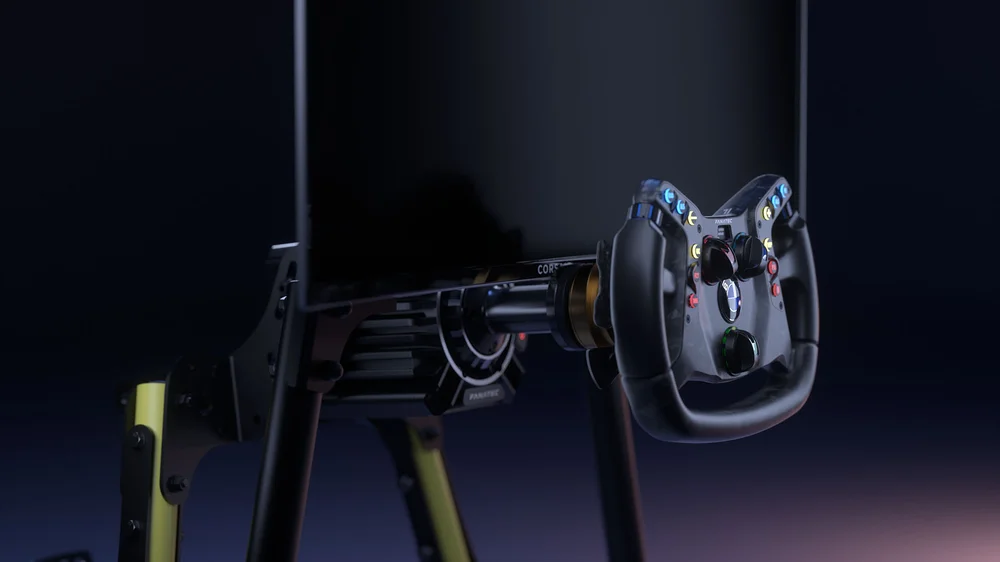
TVs are typically much larger, which can be challenging to position in the exact center of the driver's eye line. TVs are usually positioned in front of the cockpit frame rather than on top of it.
When a TV can make sense
A high-end TV is a valid option in specific cases. For console use it is the logical choice, because consoles do not generally support ultrawide or triple resolutions and the games are optimized for viewing on TVs.
But even for PC sim racing, premium TVs using self-emitting technologies like OLED are now a valid choice. With 120 Hz or higher and variable refresh rate options and low-latency game modes, OLED TVs can produce superior image quality and motion clarity than a typical PC monitor. If immersion and wow-factor is the priority, then three large OLED TVs in a triple configuration is the ultimate choice.
However, for PC-based sim racing where precision and performance matter most, premium gaming monitors still have the edge. Lower overall latency, higher refresh rates, and cockpit-friendly formats make monitors the logical choice for competitive driving where every millisecond counts. Today, OLED gaming monitors are becoming more affordable, where you could potentially have the best of both worlds.
PRODUKTY V ČLÁNKU