Why H-pattern layouts differ
In real cars, the number of gears and their positions and spacing are usually determined by mechanical constraints of the transmission. Most drivers are familiar with the standard 5-speed or 6-speed pattern, but there are several variations, including dogleg and 7-speed layouts.
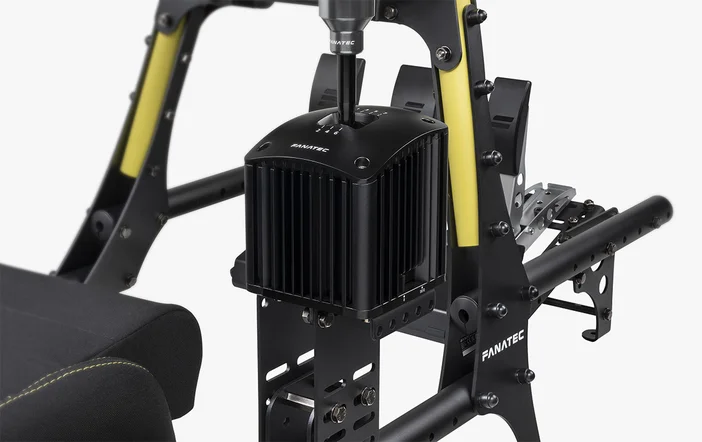
For sim racers, an H-pattern shifter like the ClubSport Shifter SQ V1.5 allows you to experience all of these patterns, because most sims allow the assignment of each gear individually. Practicing on different layouts makes it easier to adapt when moving between different road cars and race cars.
The ClubSport Shifter SQ V1.5 can connect directly to Fanatec Bases via RJ12, or used as a standalone USB device on PC. Find out more here.

The basic 5-speed layout
The classic 5-speed H-pattern is the most widely used:
- Top row: 1st, 3rd, 5th
- Bottom row: 2nd, 4th, possibly reverse (or a lockout position nearby)
This layout keeps the most-used gears close together. The shift from 2nd to 3rd is especially natural because it follows a simple straight-line motion with the spring-centred lever guiding the driver back into the middle gate.
Reverse is normally separated by position or lockout so it cannot be selected by mistake while driving forward.
The common 6-speed layout
The 6-speed pattern adds another forward ratio without changing the basic logic:
- Top row: 1st, 3rd, 5th
- Bottom row: 2nd, 4th, 6th
- Reverse: usually offset, with a lockout
This became common as road cars gained broader performance ranges and longer gearing for highway use. The wider gate means precision matters more, particularly at the far-right side of the pattern.
For performance driving, that added ratio can improve flexibility, but it also makes familiarisation more important. A clean shift depends on controlled lateral movement rather than rushing across the gate.
The rare 7-speed pattern

A less common but notable variation is the 7-speed H-pattern, most closely associated with certain Porsche 911 models. Porsche has offered seven-speed manual gearboxes on selected 911 variants with the 7th gear being very long for fuel saving. It takes a typical 6-speed pattern and adds one more gate.
This unusual layout directly inspired the ClubSport Shifter’s 7-speed support. Unlike the real Porsche box that has a special unlock after being in 5th or 6th gear, the Fanatec 7th gear has the same physical lockout like the reverse, where you have to push down on the stick to allow the engagement.
7th is intentionally harder to engage quickly, reducing the chance of an accidental shift when going from 4th up to 5th, or from 6th down to 5th.
Dogleg patterns in performance cars
Another notable variation is the dogleg pattern, where 1st gear sits separately, usually up and to the left, while 2nd and 3rd form a straight vertical line. Famous cars featuring a dogleg 1st include the BMW M1, Ferrari 512 BB, and Mercedes 190E Evo II.
Racing drivers spend almost all their time in 2nd to 4th, so those gears must be the fastest and easiest to shift between.
The pattern is less intuitive for normal road use, but very effective in cars where rapid shifts between the main performance gears matter most.
You can simulate a dogleg 1st with the ClubSport Shifter by reassigning the gears in software.
PRODUCTS IN ARTICLE